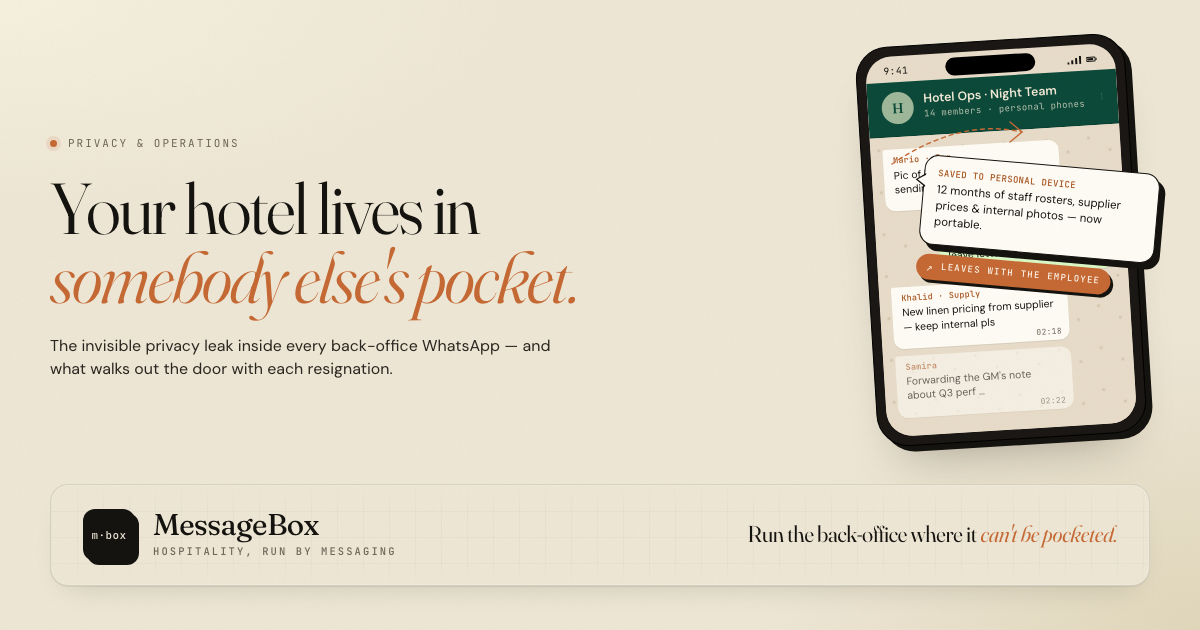
Walk into the back office of almost any hotel and the real operating system isn't the PMS or the scheduling software.
It's a mess of overlapping WhatsApp groups living on people's personal phones.
Housekeeping coordination, maintenance requests, shift changes, night audit notes, supplier issues, staff problems — all flowing through a consumer app never built for business. One group for rooms, another for F&B, a third for "urgent stuff," a fourth that somehow became permanent even though it was only meant for one event.
The privacy problem starts the moment work moves onto personal devices. Every message, photo of a broken fixture, staff roster, internal note, or operational discussion now sits on someone's private phone. There is no company-controlled encryption at rest. No central admin who can remove access the second someone hands in their notice. No audit trail of who saw what and when.
When a team member leaves — and in hospitality that happens constantly — they walk out with months or years of internal history in their pocket. The hotel has zero visibility into what operational details, sensitive discussions, or internal photographs just left the building. That data doesn't disappear because someone deletes the app. It stays on the device, in cloud backups, and potentially in the hands of whoever picks up the phone next.
Confidentiality takes the same hit. Conversations that should stay inside the operation — discussions about staffing levels, supplier pricing, maintenance priorities, or internal performance issues — are now scattered across personal chats with no controls. A single misdirected message or an ex-employee with a grudge can expose far more than anyone intended.
Regulators notice these things. Using an unregulated consumer platform for internal coordination creates exactly the kind of uncontrolled data flows that data protection rules were written to prevent. Phone numbers of colleagues become visible to everyone in the group. Messages can be forwarded without any record. Backups often sit unencrypted in personal cloud accounts. None of this meets basic standards for handling operational information.
The human cost makes it worse. Because the same app carries both work and family life, staff never fully switch off. Notifications arrive at dinner, on days off, at 2 a.m. The boundary between professional responsibility and personal time dissolves. That exhaustion doesn't just hurt people — it increases mistakes, turnover, and the very chaos that made the WhatsApp groups feel necessary in the first place.
Hotels that run this way aren't just being informal. They're accepting a permanent, invisible leak of operational privacy and confidentiality in exchange for short-term convenience. The groups feel free because they cost nothing to set up. The real price shows up later — in lost control, compliance exposure, and institutional knowledge walking out the door with every departing employee.
The operations that are getting this right have stopped pretending a consumer messaging app can safely carry the internal nervous system of a hotel. They moved to platforms built for teams, with proper access controls, retention policies, and separation between work and personal life.
Everything else is just hoping the next person who leaves doesn't take the hotel's internal history with them.