For the past eleven years, we at MessageBox have built our company here in the UAE. Watching this country respond to pressure has shaped how we think about resilience — not as something you endure, but as something you build through.
For decades, the UAE has treated every major shock as raw material for its next phase of growth. The pattern is consistent and deliberate.
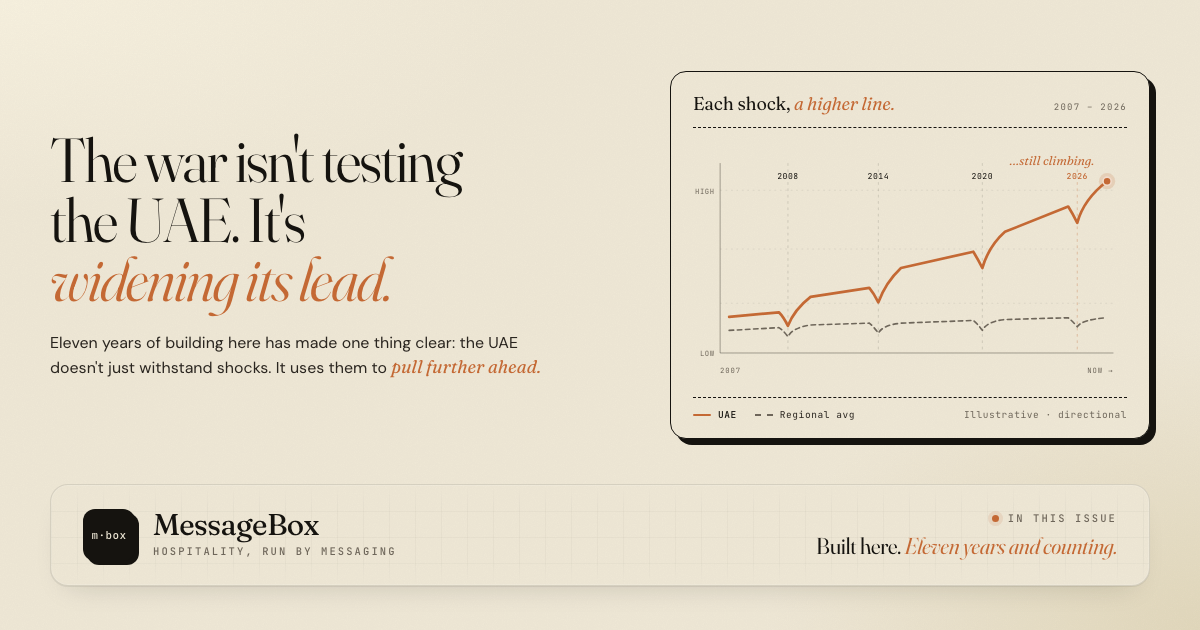
During the 2008 global financial crisis, the country responded with coordinated support and structural reforms that reinforced its financial foundations and allowed ambitious development to continue. In 2014, when oil prices collapsed, the response wasn't to defend the old model. It was to accelerate diversification into tourism, aviation, logistics, finance, and technology. By the time COVID hit in 2020, the non-oil economy was already large enough to absorb the blow. Tourism and aviation were devastated, yet within two years the UAE was running one of the region's most successful post-pandemic recoveries while executing Expo 2020.
Each time, the same mechanism appeared: short-term pain, rapid adaptation, and a clearer strategic direction afterward.
Now the region is once again in conflict. Flights have been disrupted, tourism has taken a hit in the early months, and uncertainty has returned to parts of the Gulf. The surface picture looks familiar — another external shock pressing on the UAE's key sectors.
But the underlying reality is different this time. The UAE no longer needs to prove it can survive regional instability. It has already built the destination that capital, companies, and talent choose when the rest of the region becomes harder to operate in. Its non-oil economy now accounts for over 77% of GDP. Its regulatory framework, quality of life, safety, and connectivity have turned it into the default neutral hub for anyone who wants regional exposure without regional risk. When tensions rise elsewhere, the movement isn't just defensive — it is often directional. Money, headquarters, family offices, and high-net-worth individuals don't just stay put. They actively route through the UAE.
This is the part that makes the current moment structurally different from 2008 or 2014. The same conflicts that create friction for others are increasing the relative value of stability, predictability, and world-class infrastructure. The UAE doesn't have to chase this capital. The environment is pushing it there.
History shows the country doesn't just endure these periods. It compounds through them. The current war is unlikely to break that pattern. If anything, it is making the gap between the UAE and every other regional player more visible and more durable.
The conflicts aren't asking the UAE to prove its resilience again. They're making its lead harder to close.