Self-service kiosks, mobile keys, and fully automated check-in feel like an obvious win. Guests say they want speed and minimal friction. Hotels save on labour during a staffing squeeze. Queues shrink, and the upsell screen never forgets to ask. On paper it's efficient, modern, and exactly what post-pandemic travellers asked for.
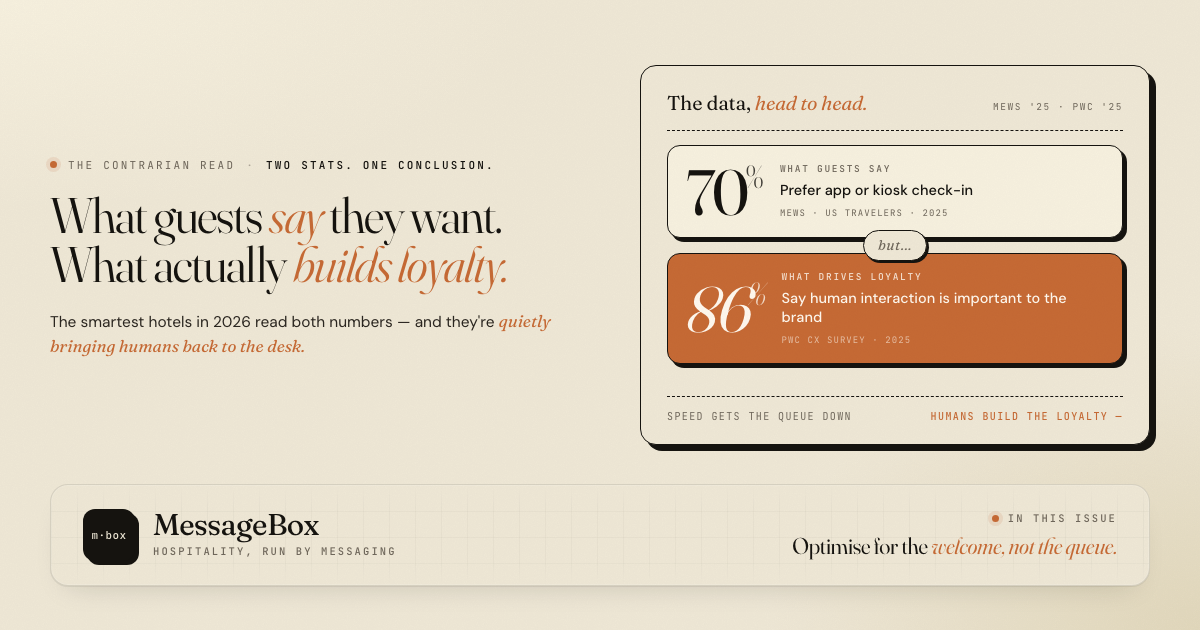
The appetite is real. A 2025 Mews survey found 70% of American travellers prefer app or kiosk check-in. A rigorous study of a large hotel group found kiosks measurably lifted satisfaction — through both the practical value of a faster process and the simple pleasure of feeling modern and in control. For a solo business traveller who knows the drill and just wants the key, self-service is genuinely better.
But hospitality isn't a series of transactions. It's a sequence of moments where something goes wrong, emotions run high, or a small personal touch creates loyalty out of all proportion to its cost. And that's where the second number lives.
PwC's 2025 Customer Experience Survey found that 86% of consumers say human interaction is moderately or very important to their brand experience. Strikingly, even the heaviest users of AI — the people most comfortable with automation — show stronger loyalty when a brand balances the technology with real people.
Self-service is excellent at the straightforward case and quietly poor at the moments that define a stay: the family arriving after a delayed flight with tired kids and a special request; the loyalty member who expects to be recognised (and, research suggests, gets less satisfaction from a kiosk, not more); the guest with a complaint that needs judgment, not a touchscreen. When a machine can't sense frustration or bend a rule, the guest doesn't feel efficient. They feel abandoned — and that feeling shows up in the reviews, the NPS, and the booking they don't make next time.
The counterintuitive part is that the answer isn't "fewer kiosks." It's a better division of labour.
The properties quietly outperforming aren't eliminating humans — they're using automation to absorb the routine so their staff can do what only people do well: read a room, show empathy, recover a bad moment, and make a guest feel seen. Self-service clears the simple majority of arrivals fast. Well-trained staff, no longer buried under a queue, are free for the high-value and high-complexity cases. And the guest's history, surfaced at the right second, makes the human exchange feel personal instead of generic.
For an operator, that turns into a short, testable list. Don't pull humans off the desk during peak arrivals — that's exactly when a person prevents a bad first impression. Make self-service genuinely excellent, but optional, not a fallback that feels cheap. Arm the team with guest context so their version of "fast" beats anything a kiosk can do. And measure the right things: not just check-in speed and kiosk adoption, but arrival-experience sentiment, repeat bookings by segment, and what a guest spends after a human interaction versus a screen.
In an era when automation is everywhere, genuine human service becomes rarer — and so it becomes more valuable, not less. The hotels winning in 2026 aren't the ones with the most kiosks or the fewest staff. They're the ones using technology to amplify their people, precisely where it counts.
Most hotels optimise for speed at check-in.
The best ones optimise for whether anyone was happy to see them.
The best ones optimise for whether anyone was happy to see them.