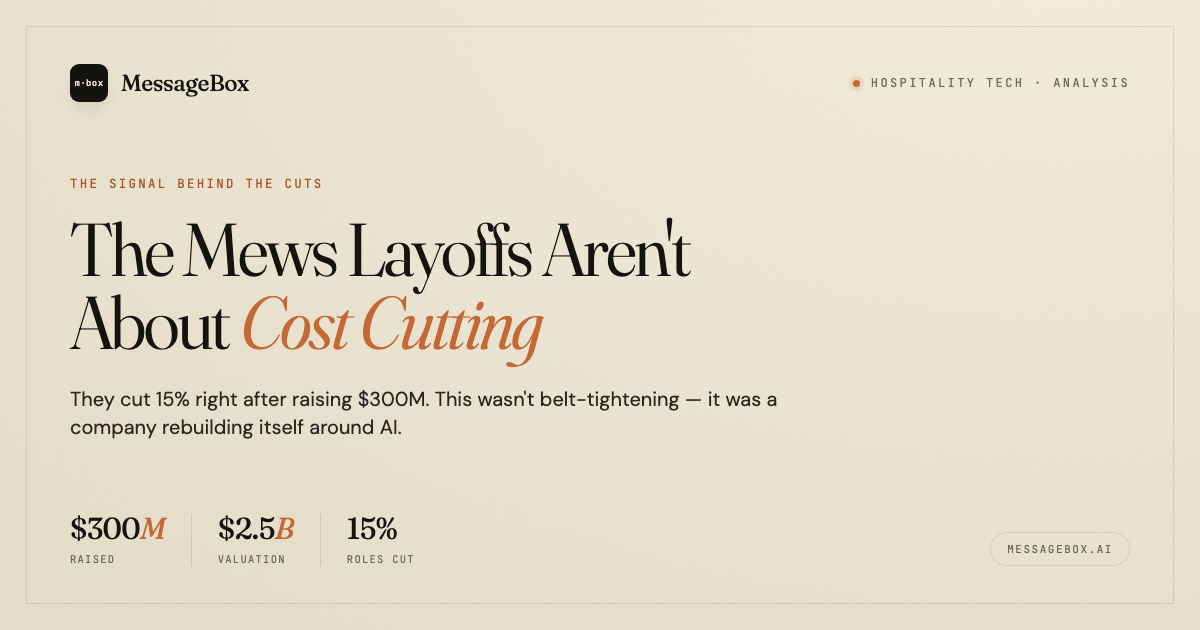
Mews just cut 15% of its team. They did it right after raising $300M at a $2.5B valuation.
That isn't a "we're struggling, so we're trimming fat" move. It's something far more deliberate.
Mews is becoming an AI-native company. The roles they removed were mostly the internal handoffs — the layers between design, product, and engineering that AI can now collapse. One person with the right tools can do work that used to require several specialists passing things back and forth. So the specialists whose main job was managing those handoffs are the ones who went.
Founder Richard Valtr was blunt about it: these were roles built, in his words, "for an era that is ceasing to exist, because of the fact that a singular employee can do so, so much more with AI." Customer-facing roles were largely protected. The company is still hiring in some areas.
Here's what actually matters, and it has nothing to do with Mews specifically.
Every hospitality tech company is about to face the same choice. You can become the AI layer that runs hotel operations — or you can become the company that gets replaced by it. There isn't a comfortable third option where the org chart from 2019 survives intact.
Mews chose the first path. They're not cutting to survive; they're cutting to lead the next version of the industry. That's an uncomfortable thing to watch, and an easy thing to misread as weakness — which is exactly why most companies will wait.
They'll wait until the market forces the same decision on them. And by the time it does, the people who could have built the new thing will already be somewhere else, building it for someone who moved first.
So the question worth asking about any hospitality tech company right now isn't the one everyone is asking.
The real question isn't who's laying people off.
It's who's rebuilding around AI before they have to.
It's who's rebuilding around AI before they have to.
Mews just answered it.