Elon Musk has become the world's first trillionaire, after SpaceX's public debut pushed the company past a $2 trillion valuation and his personal fortune past the thirteen-figure line.
It's a staggering number. But the more useful story isn't the size of the fortune — it's the habit of mind that built it.
Because SpaceX very nearly didn't exist. Founded in 2002 to make humanity multi-planetary, its first three Falcon 1 launches ended in explosions. The failures drained Musk's personal resources and brought the company to the edge of bankruptcy. With the money almost gone and the aerospace establishment writing him off, he committed to one final attempt. The fourth launch, in 2008, made it to orbit — and breathed life back into the company. From there: reusable rockets, reliable crewed missions to the ISS, Starship, and now the IPO.
The same pattern runs through the rest of the portfolio. Tesla proved electric cars could be desirable rather than a compromise. Starlink put high-speed internet over regions the cabling never reached. Each one started as an improbable bet and delivered outsized impact.
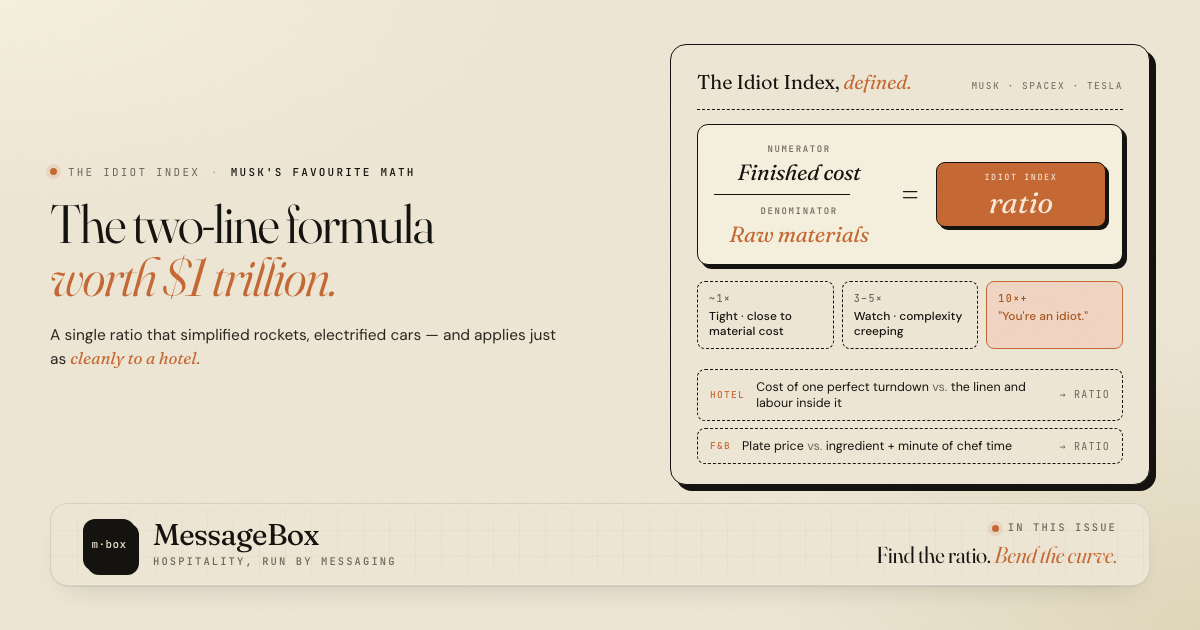
None of that happens without a way of cutting through complexity. Musk's is almost embarrassingly simple. He calls it the Idiot Index.
That's it. Take a finished component and divide what it costs by what the raw materials inside it cost. A part machined from a few dollars of aluminium that ships at several hundred dollars has a high index. And a high index, in Musk's blunt phrasing, means "you're an idiot" — not because the part is hard, but because the gap between the metal and the invoice is being filled with complexity, markup, and process that nobody has questioned.
Applied relentlessly at SpaceX and Tesla, that one question — why does this cost so much more than the stuff it's made of? — pushed the teams to simplify designs, bring manufacturing in-house, drop unnecessary suppliers, and strip out redundant cost. The result was dramatically cheaper production, which made faster iteration possible, which made the once-unthinkable economically viable.
Now point that same lens at a hotel.
Hospitality runs on exactly the kind of layered cost the Idiot Index is built to expose: procurement, labour, energy, maintenance, and the long chain of steps between a raw input and a delivered guest experience. Most of it has never been questioned — it's simply how the property has always done things.
So ask the question component by component. What does a perfect turndown cost — versus the linen and the minutes of labour actually inside it? What's the plate price of a dish — versus the ingredients and the chef-minutes on it? What's the mark-up on a branded supply — versus the identical generic sitting on the same shelf? What do you pay per kilowatt-hour delivered to a room — versus the raw energy entering the building?
Where the ratio runs high, you've found something worth fixing — a legacy supplier, an over-engineered process, a step that exists only because no one removed it.
The point isn't to copy a rocket company. It's to copy the question. Musk didn't just build rockets and cars — he built a way of thinking that turns complexity into clarity, and the discipline travels into any industry with tight margins and rising expectations.
The real question was never "how do we improve?"
It's "what are we still doing that no longer makes sense?"
It's "what are we still doing that no longer makes sense?"