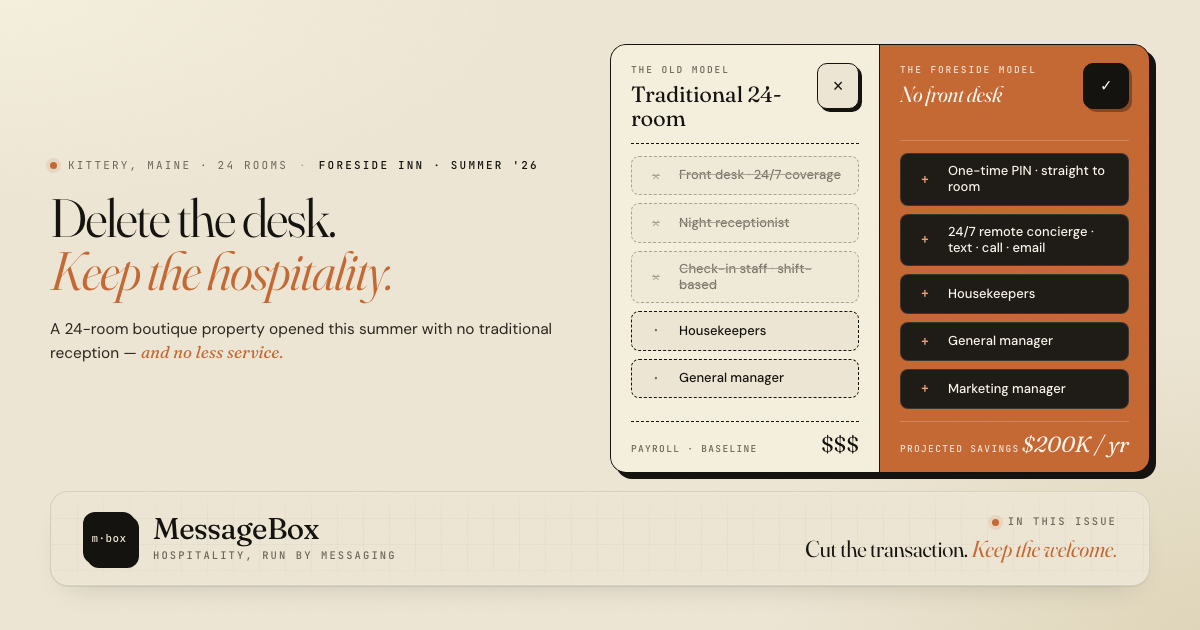
Most hotels still treat the front desk as non-negotiable. The Foreside Inn in Kittery, Maine decided it was optional.
The 24-room boutique property opened this summer with no traditional reception. Guests receive a one-time PIN, walk straight to their room, and handle everything else through a 24/7 remote concierge reachable by text, call, or email. On-site staff is deliberately lean: housekeepers, a general manager, and a marketing manager. That's it.
Owner Taylor McMaster projects roughly $200,000 in annual savings compared with a conventional staffing model for a hotel this size.
The technology is straightforward: digital access codes and a remote support team. The operating insight is the sharp part. Once you separate the transaction — the ID check, the card swipe, the key handover — from the hospitality, you can see how much of the desk was only ever the former. And once the transaction is automated, those hours become negotiable.
It's worth being precise about what Foreside did not cut. Not the concierge — it's staffed 24/7, just off-site. Not housekeeping. Not the human on the other end of a text at 11pm. What went was the physical counter and the shift-based bodies whose main job was standing behind it. The welcome stayed; the furniture and the roster around it didn't.
Plenty of smaller hotels are still paying for full desk coverage out of habit. This one is testing whether the habit is still necessary — and if a 24-room property can run this way and still feel like a boutique hotel, the answer is going to be uncomfortable for a lot of operators.
The real question it leaves for the rest of the industry is simple.
How much of your front desk is hospitality?
And how much is just inertia?
and how much is just inertia?