Every conference has the same slide. A guest named Sophia lands. An invisible genius has already booked the car, moved dinner, chilled the minibar and emotionally prepared the pillows. Sophia has asked for none of this. She does not need to. The agent ‘knew’.
In the hotel, Dave types: “Wifi password?”
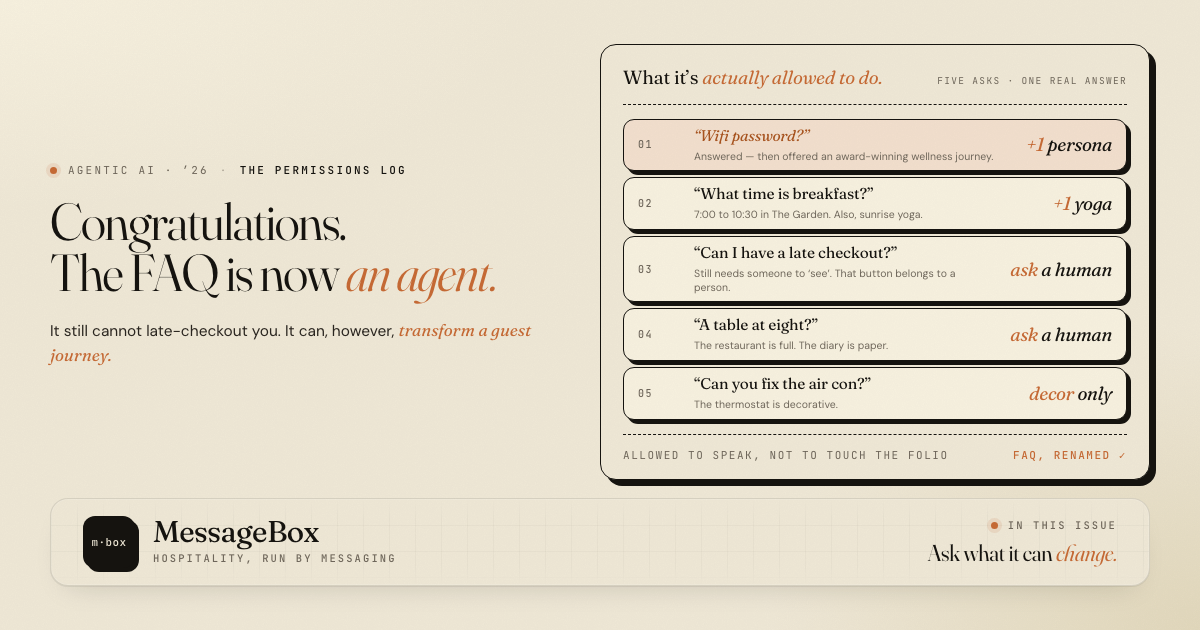
The agent replies: “Happy to help! The Wi-Fi is HotelGuest. Password: Welcome2024. Would you also like to explore our award-winning wellness journey?”
Dave wanted the password. He received a personality.
The dream version books, moves, charges and apologises. The live version knows breakfast hours and would like to discuss them at length. “The pool closes at 10” is now ‘autonomous orchestration of the in-stay experience’. “Can I have more towels?” is ‘proactive fulfilment across the guest lifecycle’.
Before AI, the guest journey was already a journey in the way a delayed train is a journey. You book. You get eleven emails. The room is “just being prepared.” Late checkout needs someone to “see.” The restaurant is full. The air conditioning is auditioning for a horror film.
Now we add the agent.
In the brochure, it runs the whole stay. In the building it cannot late-checkout you, seat you or fix the air. Those buttons still belong to people, paper diaries and a thermostat that is decorative.
So it does the trick it knows.
You: “What time is breakfast?”
It: “7:00 to 10:30 in The Garden. Guests also love sunrise yoga. Shall I check availability?”
You mentioned eggs. It has concerns about your soul.
True agency would be worse. Flight late? It pushes dinner. Fine. It also books 6:30 a.m. Pilates because your watch tattled, upgrades you to a tub because you once wrote “soak,” and pre-charges the minibar as a courtesy. At that point the stay has been rearranged by a helpful relative. You cannot find the kettle.
Hotels know this. That is why the agent is brave in PowerPoint and on a short lead in the building. A wrong pool time is a shrug. A wrong charge is a review.
Simple test: what is it allowed to change?
“The guest experience” means you bought a conversation.
“Towels, late checkout, a table at 8” means you may have bought a small adult.
“It orchestrates every touchpoint” means you bought a sentence.
Most hotels fail in the first minute. The reservation system does not speak to the restaurant. The restaurant does not speak to the spa. The spa does not speak to the door lock. Into this family argument we drop a language model and ask it to run the house.
It runs the FAQ. Someone names the FAQ after a butler.
A bot that can say “the gym is on three” at 2 a.m. is useful. Night auditors have been answering that since the invention of stairs. That is operations. Dull is where the money is.
Dull does not get a keynote. “We reimagined hospitality as an autonomous continuum” does. So the continuum is announced. Sophia is invented. Dave still wants the password.
Can agentic AI transform a guest journey?
It can stop you ringing reception to ask if the pool exists. In a few hotels whose software is on speaking terms, it can send towels or hold a table. It cannot turn your stay into a film where the algorithm plays Jeeves.
Most of the time it is a very keen dog with a vocabulary. You say “ball.” It brings the park. You say “pool.” It brings pool hours, a spa package and a short talk on balance.
You came for a bed.
You got a journey.
The journey would like to know if you need extra towels.
Say yes.
Do not say “transform.”
It will only try.
The journey would like to know if you need extra towels.