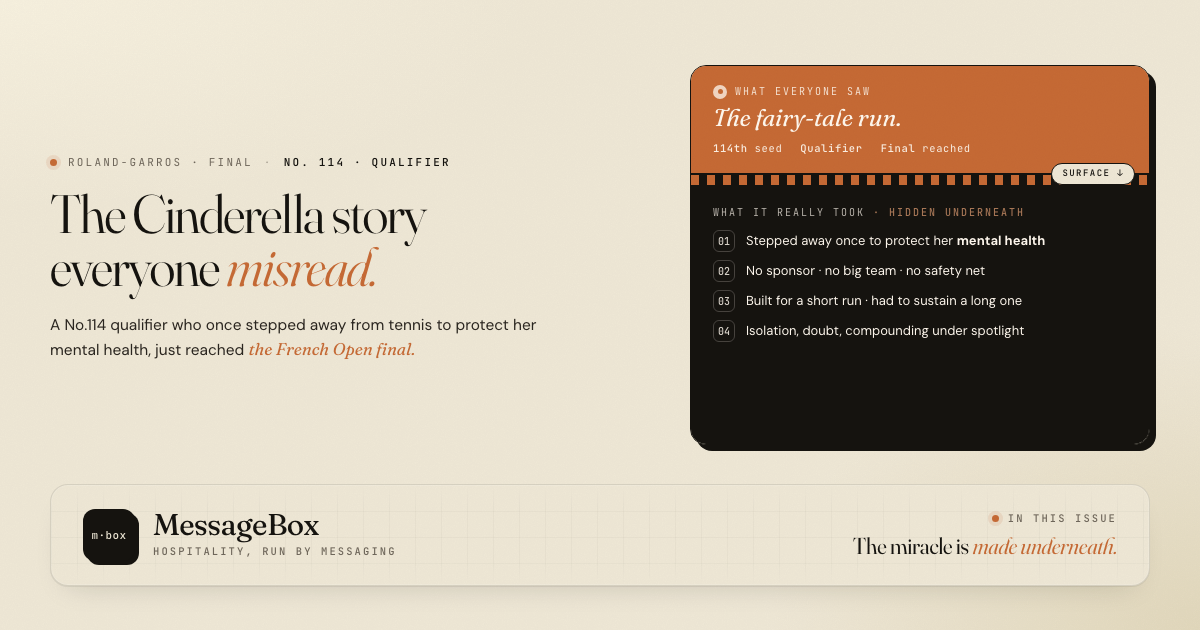
Maja Chwalińska, the Polish No.114-ranked qualifier who had never won more than one Grand Slam match before this tournament, just made the 2026 French Open final.
Everyone is calling it the ultimate Cinderella story.
The uncomfortable truth is that the fairy tale hid months — and years — of real, quiet struggles. She had previously walked away from the sport entirely to save her mental health and wasn't sure she would ever return. Coming back as an unsponsored player with limited resources, she had to grind through qualifying rounds just to get in the door, with no big team, no safety net, and no expectation of going deep. Then the miracle run happened: match after match, week after week, the physical toll of far more high-stakes tennis than she had budgeted for, combined with the mental weight of performing under constant doubt and isolation.
This isn't "bad luck." It's the brutal reality of being the ultimate underdog — where success itself becomes the new pressure, and the systems you built for a short, modest run suddenly have to sustain something much bigger and longer than planned.
Hospitality faces this exact hidden mechanic every single day.
Your frontline team shows up ready for a normal shift. Then the property hits record occupancy, a viral event lands, or a difficult guest requires extraordinary service — and suddenly the "qualifier" staff member is being asked to deliver three weeks of peak performance they weren't resourced or mentally prepared for. Burnout creeps in. Doubt sets in. The invisible load — emotional labour, irregular hours, personal pressures — compounds exactly like an unexpected deep run in a Grand Slam.
Most operations romanticise the "Cinderella shift" — the heroic save, the glowing review, the record numbers. The best ones do something different. They deliberately build support for the underdog moments: mental-resilience training, flexible scheduling buffers, quiet peer-support systems, and leaders who check in before the crash happens. They treat the long, unexpected run as the real test, not the exception.
The fairy-tale ending looks magical on the outside.
The real magic belongs to whoever fought their own qualifying rounds first.
The real magic belongs to whoever fought their own qualifying rounds first.