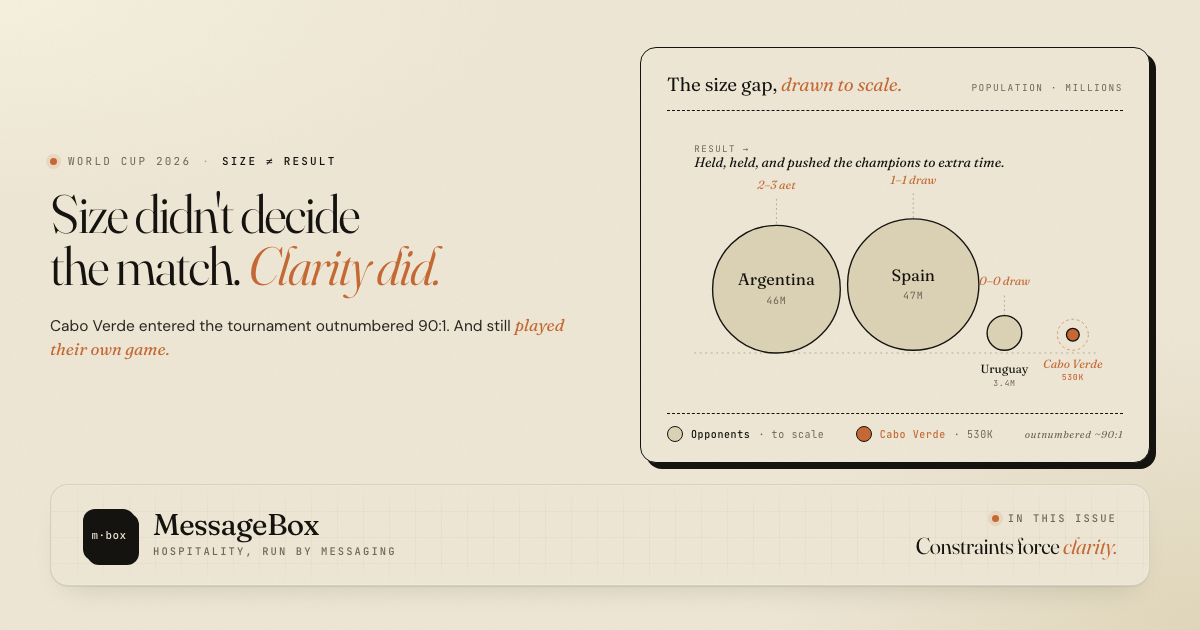
Cabo Verde just reminded the world what's possible when you stop complaining about what you don't have and get ruthless about maximising what you do.
A nation of roughly 530,000 people — smaller than many cities — reached the knockout stages of the 2026 World Cup on their first-ever appearance. They drew with Spain. They drew with Uruguay. They took the defending champions, Argentina, to extra time in a 3–2 thriller. No deep bench, no expensive squad, no marquee names. What they had was clarity, cohesion, and the discipline to play to their strengths.
It's one of the purest modern examples of managing with what you have — and the lesson isn't really about football.
Cabo Verde did the opposite. They built around defensive organisation and counter-attacking efficiency instead of trying to out-possess bigger nations. They maximised each player's specific strengths rather than forcing a generic system. They created an identity that made them dangerous despite the gap in resources — not by pretending the gap wasn't there.
That's exactly what separates the hospitality businesses that thrive from the ones that struggle.
Big chains win on scale and amenities. Small and independent properties win on experience, personality, and consistency. Cabo Verde didn't try to play like Brazil or France — they played like Cabo Verde, and it worked. The equivalent on the floor is to stop competing on facilities you can't afford, and perfect the things you actually control: service culture, local authenticity, staff empowerment, operational discipline.
Underneath all of it sits the team. With limited resources, Cabo Verde got maximum output from every player through clear roles, trust, and preparation. In hospitality that means investing hard in training, culture, and retention — because a well-drilled, motivated team of 15 will out-perform a disengaged team of 40. Cohesion beats individual talent: a property with average rooms and exceptional teamwork beats one with beautiful rooms and a broken culture, every time.
None of this is a licence to romanticise constraints. Cabo Verde didn't win the tournament. But they proved the thing worth proving: the operators who thrive over the next decade won't necessarily be the ones with the biggest budgets or the fanciest properties. They'll be the ones who get brutally honest about their limits — and build something powerful anyway.
Play your own game.
Maximise what you have — the results might surprise everyone, including you.
Maximise what you have — the results might surprise everyone, including you.