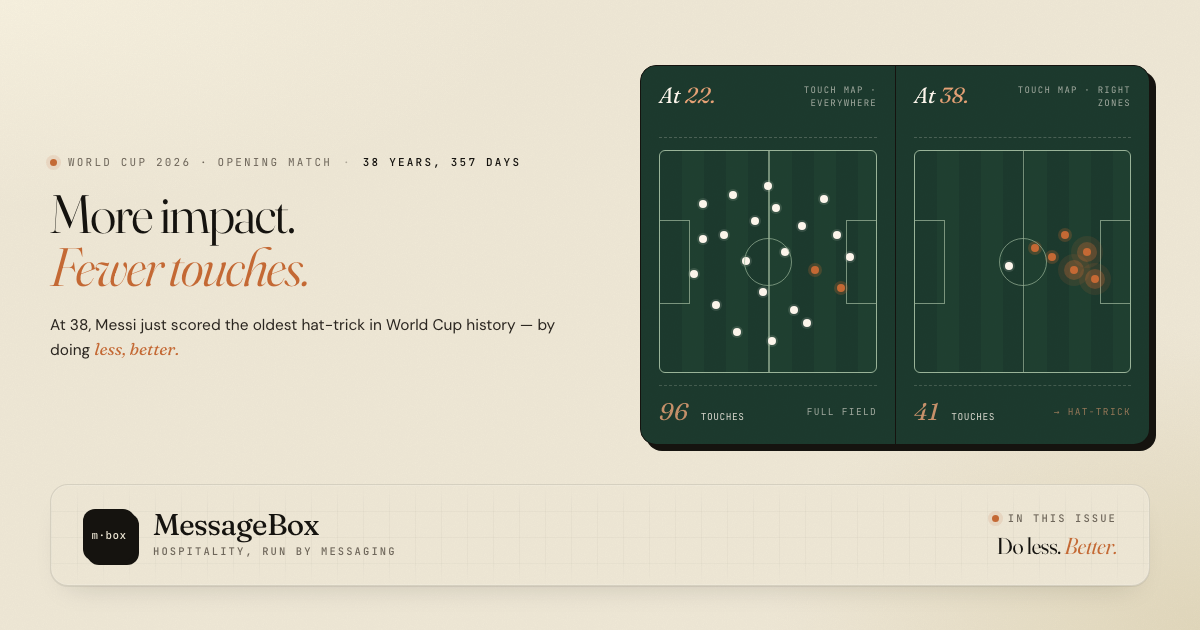
At 38 years and 357 days old, Lionel Messi did what almost nobody believed was still possible. In Argentina's opening match of the 2026 World Cup he scored a hat-trick — his first ever in the tournament — and became the oldest player in men's World Cup history to do it.
Most footballers his age stepped away from the top level years ago. Messi is still rewriting expectations.
But the goals aren't the interesting part. How he scored them is.
At 38, Messi no longer relies on explosive speed or ninety minutes of relentless running. He dominates through positioning, sharper decisions, and an almost surgical read of space and timing. He has evolved from a dazzling dribbler into a more efficient version of himself — more impact, fewer touches, less wasted output. In an era obsessed with athleticism, he's a reminder that craft doesn't just survive; it can keep getting sharper.
That kind of sustained excellence is exactly the problem hospitality wrestles with.
Operational demands keep rising. Guest expectations keep shifting. And teams are asked to perform at a high level even as resources, conditions, and staffing move underneath them. The instinct is to push harder — more initiatives, more intensity, more hours — until the people carrying it all burn out.
Messi's longevity points at a different answer. Peak performance doesn't have to decline with time, and it doesn't have to be bought with brute force. It can be maintained — and even refined — through smarter systems, deeper experience, and a relentless focus on the few things that actually move the guest.
So instead of chasing every new trend or running teams into the ground, the operators who last do what the older Messi does: they prioritise precision over volume, they put experience where it has the most leverage, and they keep adapting without losing the identity that made the property worth choosing in the first place.
The advantage rarely belongs to whoever runs the most. It belongs to whoever keeps getting better at the things that matter most.
Greatness doesn't fade when you get older.
It fades when you stop evolving.
It fades when you stop evolving.