There is a new sort of office hero. Between meetings, he builds an app.
He may be new to the firm. He may run it. Rank does not matter. The official system is slow, AI is willing, and by late afternoon there is a button that does the job everyone has been meaning to do for years.
People are pleased. That is usually the moment to stop.
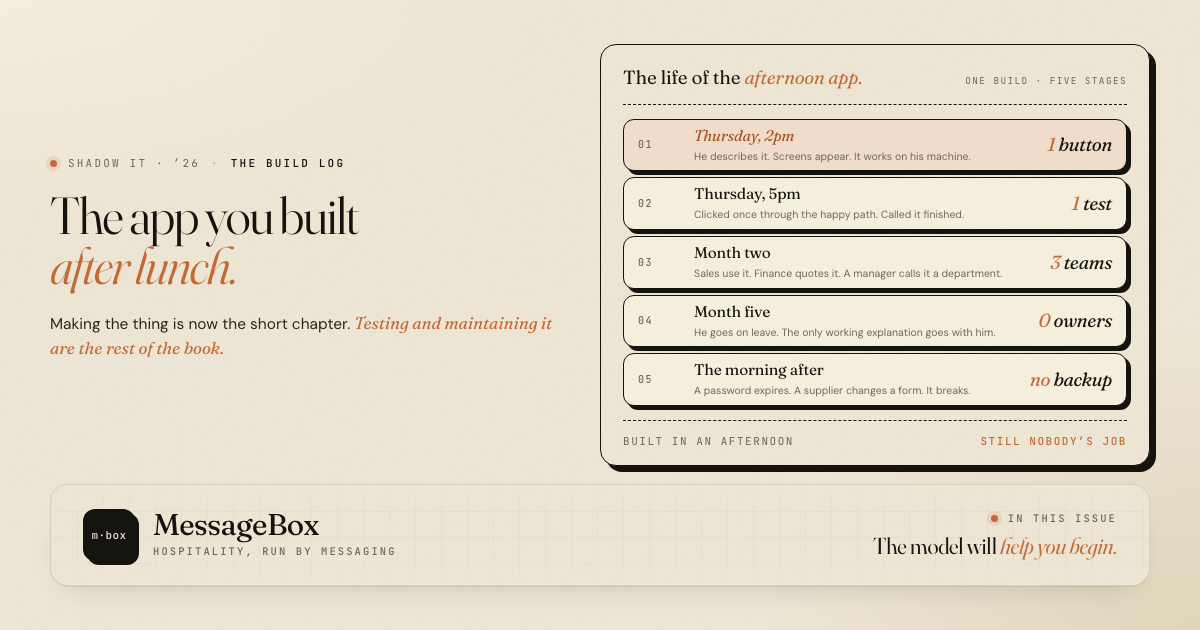
The impulse is understandable. Company tools can be clumsy. AI has removed the old excuse that building something was too hard. You describe what you want. Screens appear. It works on your computer. The hard part, you tell yourself, is over.
Testing is treated as a formality. The builder clicks through the happy path once, sees the result he expected, and calls it finished.
He does not ask what happens when two people press the button together, or when a name has an apostrophe, or when the other system is down, or when someone uploads a file the size of a novel. Official teams exist to be suspicious. Homemade apps are tested by someone already fond of them.
Then that person goes on leave.
An app is not a one-off favour. Passwords expire. A supplier changes a form. A colleague leaves with the only working explanation still in his head. The business, by then, has started to depend on it. Sales use it. Finance quotes it. A manager mentions it as if it were a department.
When it breaks, people look at the builder. The builder looks at last year’s chat with the model. The model offers, cheerfully, to start again.
It will not be the same app. It never is.
Security is the quiet problem, which is why it is ignored until it is not.
A homemade app is often in a hurry. Customer lists sit wherever seemed convenient. A password is borrowed from something else. Secret keys are left in the code. It is wired, with the best intentions, to mail, files, and other people’s data.
None of this feels serious on a Thursday, when the button works and the boss is smiling. It feels serious later, when the question is no longer whether it works, but who else has been using it.
Good intentions are not a lock. The intern did not mean to leave a door open. The director did not mean to put last quarter’s numbers behind a password a child could guess. Meaning well does not close the door.
Seniority is no help.
The junior builds because nobody told him not to. The senior builds because nobody tells him not to, and he is tired of waiting. The junior’s app is a nuisance. The senior’s app is a nuisance that looks like policy.
Both can leak. Both can rot. Both can become the one tool the business cannot do without and nobody can explain. A title does not imply a backup. It often implies that fewer people will ask for one.
If the company needs the app, give it a proper home: someone to own it, tests that are not “it worked for me,” and a door that shuts. If it is a private shortcut, keep it private. Do not feed it the customer list to see if it will sit up.
AI has made the first evening easy. The morning after is unchanged. Something still has to be tested. Something still has to be maintained. Someone still has to notice the side door.
The model will help you begin.
It will not be there when the letter arrives.
It will not be there when the letter arrives.