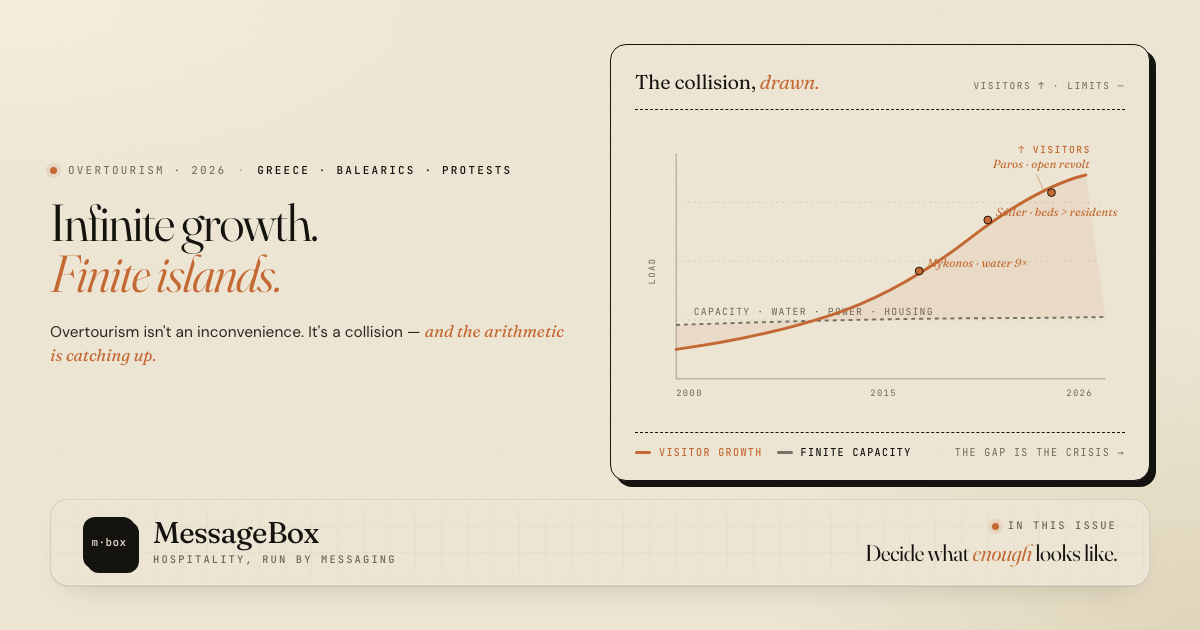
On Greek islands, daily water use can jump nine times higher in summer.
On Mallorca, thousands of residents have taken to the streets.
On Paros, a nearly finished luxury hotel with 46 private pools has sparked open revolt.
The numbers keep rising. The infrastructure does not.
Overtourism is usually framed as an inconvenience — too many people on the beach, long lines, noisy streets. That framing is too soft. What is actually happening is a collision between infinite visitor growth and finite places.
Popular destinations are discovering the hard arithmetic. In some island municipalities, tourist beds already outnumber residents. House prices double. Seasonal demand turns scarce resources into crisis points, and the crunch arrives every year at exactly the moment the operation can least absorb it.
The industry still measures success in arrivals and bed-nights. Residents measure it in whether they can still afford to live where they grew up, swim on a public beach, or get water in August. Those two scorecards have been drifting apart for years. They are now far enough apart to be visible from the street.
Protests are no longer fringe. They are becoming structural. Governments respond with caps, taxes, rental restrictions, and development freezes — usually after the pressure has already become impossible to ignore, which is the most expensive moment to act.
The deeper issue is simple. Many coastal and island economies were built on the assumption that more tourism is always better. That assumption is breaking, and the places that keep betting on it are the ones now negotiating with their own residents.
The destinations that still feel special in ten years won't be the ones that maximised volume.
They'll be the ones that decided, early enough, what enough looks like.
the very thing people came for.